
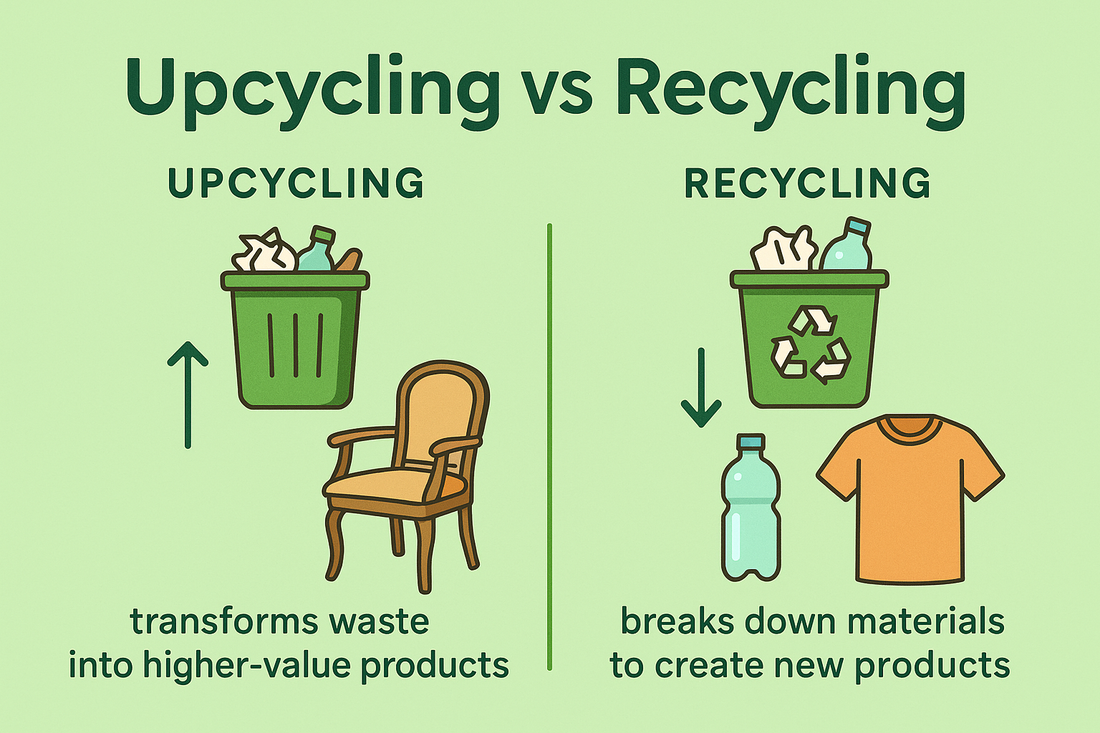
What exactly is upcycling and how does it differ from recycling?
Share
When I think of upcycling, I don't just see an old piece of fabric being reused. I see an invitation: create something new, beautiful, and meaningful from it. I'm 20, have started a small brand, and for me, upcycling is more than just a technique. It's an attitude. In this text, I'll explain exactly what upcycling means, how it differs from recycling, what ecological and economic consequences both strategies have, and how you can start yourself without falling into sustainable buzzwords.
Short version first: Upcycling transforms waste or residual materials into something more valuable or new with higher quality; recycling breaks down materials and reprocesses them into the same or other raw materials. But the differences go deeper into energy consumption, creativity, supply chains, and the question of how we create value.
Why this is important: If you, as a consumer or founder, want to make sustainable decisions, understanding upcycling versus recycling will help you choose better products or develop business models that are truly resource-efficient.
Attention: I am writing this from the perspective of a founder who has practical experience with fabric remnants, small production runs, and customer communication. This is not a scientific essay; it's a practical guide, honest and from everyday life.
What is Upcycling?
Upcycling means changing an existing material, product, or object in such a way that its value increases, be it practical, aesthetic, or emotional. An old pair of jeans becomes a bag with character; fabric scraps turn into makeup remover pads that last longer than disposable products. Upcycling is not just about waste avoidance, but about giving the original material a new story.
A few characteristics of upcycling:
-
It often works with unique pieces or small series.
-
It emphasizes design and storytelling: every piece carries its origin within it.
-
It can be local and handcrafted, perfect for small brands and manufacturers.
-
It often saves energy because no energy-intensive melting or reprocessing is necessary (depending on the material).
What is Recycling?
Recycling describes processes in which materials are collected, sorted, mechanically or chemically processed, and then reused as raw material. Old glass becomes new glass, PET bottles become fibers for textiles. Recycling is a central element of a circular economy because it reduces raw material consumption and waste volumes. But recycling has its limits: quality degradation, sorting problems, and high energy requirements for some processes are real challenges.
Characteristics of recycling:
-
Suitable for large quantities of standardized materials.
-
Often industrialized and centrally organized.
-
Can involve downcycling: high-quality materials are turned into lower-quality products (e.g., paper blends).
- Strongly depends on infrastructure and market prices for raw materials.
Direct Comparison: Upcycling vs. Recycling
Value creation:
-
Upcycling often increases the perceived or actual value of an object through design and craftsmanship.
-
Recycling makes material available again as a raw material; the product value is often only generated in new production steps.
Energy and resource consumption:
-
Upcycling can be very energy-efficient because no elaborate reprocessing is necessary.
-
Recycling requires energy for sorting, cleaning, and processing; for some materials, this effort is high.
Scalability:
-
Recycling is easier to scale because it is based on large quantities.
- Upcycling is often better suited for small, regional productions.
Quality of output:
-
Upcycling leads to unique pieces or small series with often higher quality or uniqueness.
-
Recycling can lead to quality loss (downcycling), but high-quality recycling is also possible with modern processes.
Emotional Value & Storytelling
-
Upcycling offers strong narration: origin, hands, process. This is gold for brand communication.
-
Recycling is concrete, technical, and less emotional, but essential for systemic resource cycles.
Practical examples to clarify the picture
-
Upcycling: Old linen curtains become bread bags and cosmetic bags. Each bag has different color patterns and a story: "This piece comes from a former theater costume."
- Recycling: Collected textile waste is mechanically processed into flakes, spun into yarn, and used as filling material for insulation or upholstery.
Ecological consideration — which is better?
There is no general "better." Both approaches are part of the solution. Upcycling is great for immediately creating value and building awareness. It prevents usable materials from being immediately incinerated or landfilled. Recycling is systemically relevant when large quantities need to be managed or when materials need to be technically reprocessed because they are no longer usable in their original form.
An important point: Upcycling often prevents materials from even entering the sorting and processing infrastructure, which saves transport and processing. But upcycling alone is not enough: not every material is suitable for upcycling, and not every waste can be turned into a high-quality product. For a true circular economy, we need both.
Economic Aspects
Upcycling opens up niche markets and often allows for higher selling prices because the products are unique. This is ideal for small labels, manufacturers, and creatives. However, material procurement is irregular, and production is more labor-intensive. Recycling is more capital-intensive, requires infrastructure, and creates scale-efficient supply chains. Companies that combine both strategies can be more resilient: upcycling for premium products, recycling for mass raw materials.
How you, as a founder or consumer, can effectively use upcycling versus recycling
For founders:
-
Check the material source: Are the remnants of sufficient quality for a lifestyle product?
-
Develop prototypes and test demand. Upcycled products often sell better with storytelling and good photos.
-
Build partnerships with textile manufacturers, tailor shops, or second-hand stores to continuously obtain material.
- Combine: Use upcycling for branded products and recycled raw materials for fillings, packaging, or less visible components.
For consumers:
-
Support local brands that operate transparently.
-
Ask about the origin of the material: Was the material recycled or upcycled? Both answers are good, but differently valuable.
- Repair instead of replace: This is upcycling in its smallest format.
Pitfalls & Misunderstandings
-
"Greenwashing": Not everything advertised as "upcycled" is ecologically sound. Some labels just stick an "upcycled" label on mass-produced goods. Question the origin, production method, and real savings.
-
Overestimation of upcycling: Upcycling is great, but it doesn't solve the problem of overproduction. If brands use upcycling as absolution while continuing to produce massively, a problem arises.
- Logistical limits: If upcycled products are transported over long distances, the ecological benefit can shrink. Regionality remains a strong lever.
Tips: How to start with upcycling (practical & quick)
-
Material scout: Look for local tailor shops, fabric stores, theater costume departments, or clothing manufacturers. Often, high-quality remnants lie unused there.
-
Mini-collection: Start with 5-10 prototypes. Test prices and messaging at markets or online.
-
Transparency: Openly tell where the material comes from. People buy stories.
-
Quality assurance: Check washability, durability, and possible pollutants. Not every old material is hygienically safe.
- Plan for scalability: If demand increases, clarify how you can organize material in larger quantities, perhaps through collaborations or collection campaigns.
How Upcycling Can Strengthen Your Brand
Upcycling creates differentiation. If you offer small series made from remnants, you have products that sell emotionally. Customers remember unique pieces. Additionally, you create content: "behind the scenes," material stories, and tutorials. All of this strengthens SEO, social media, and community engagement.
Final Word
For me, upcycling is a kind of reconciliation with material. It teaches you to look closer and see the potential in trivial things. Recycling is the systemic answer that needs to be thought of on a large scale. Upcycling is the practical, creative answer that begins with individuals and brands. Both belong together because they use different levers. If we seriously want to save resources, we need both technology and soul: recycling and upcycling, industry and craft, efficiency and aesthetics.